
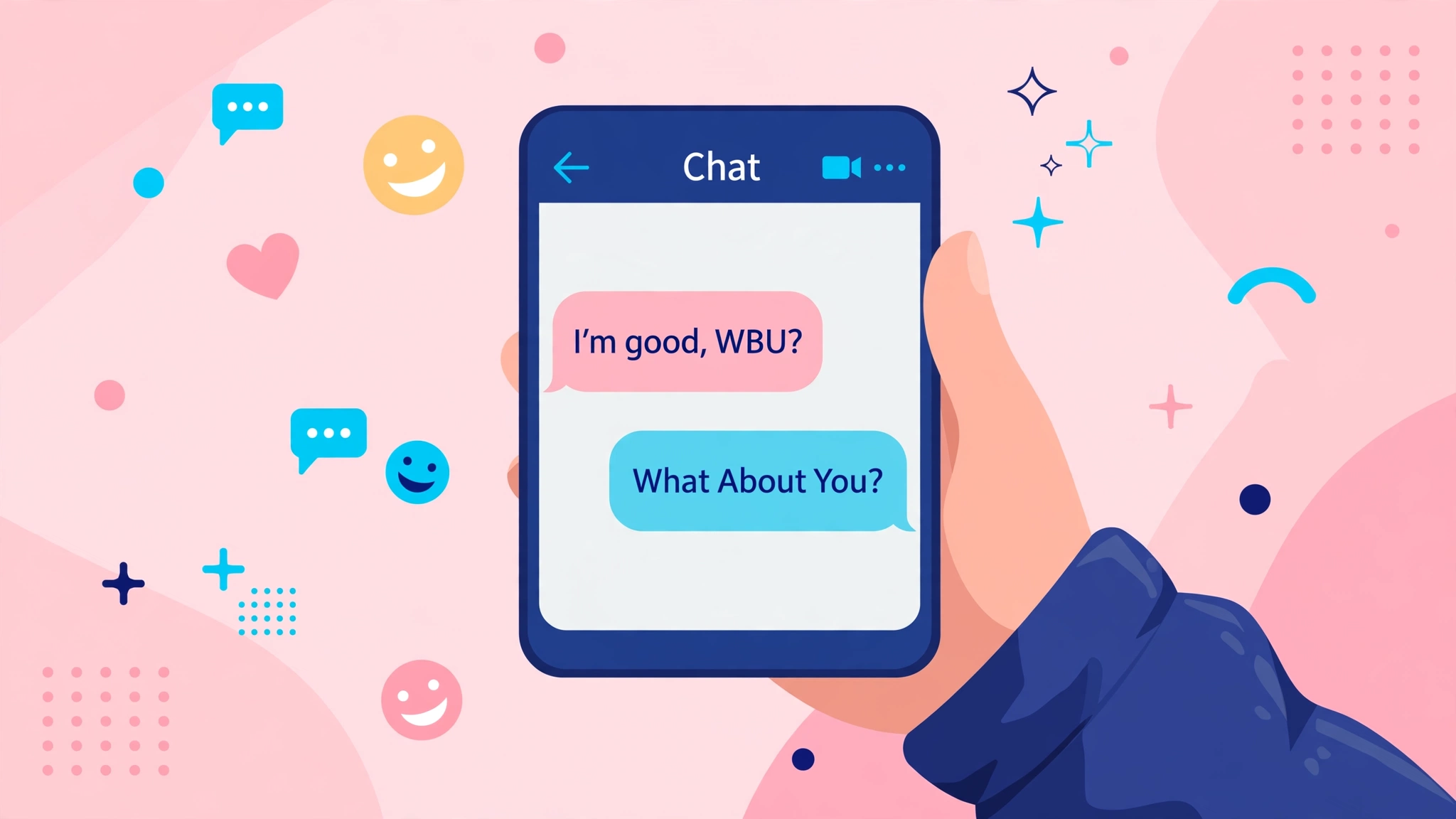
Have you ever received a text that says “I'm doing pretty well, wbu?” and wondered what the last three letters mean? If so, you're not alone. Short abbreviations are common in texting, social media comments, and online conversations, but they can be confusing when you encounter them for the first time.
The wbu meaning is “What about you?” People use this abbreviation to ask another person the same question they were just asked or to invite them to share their thoughts, feelings, plans, or experiences. For example, if someone texts, “I'm watching a movie, wbu?” they want to know what you're doing.
Although WBU is simple, understanding its tone and context can help you respond naturally. It might appear in a friendly conversation with a friend, a casual exchange with someone you just met, or a message on Instagram, Snapchat, TikTok, or another social platform. The meaning generally stays the same, but the situation determines what kind of answer makes sense.

What Does WBU Mean?
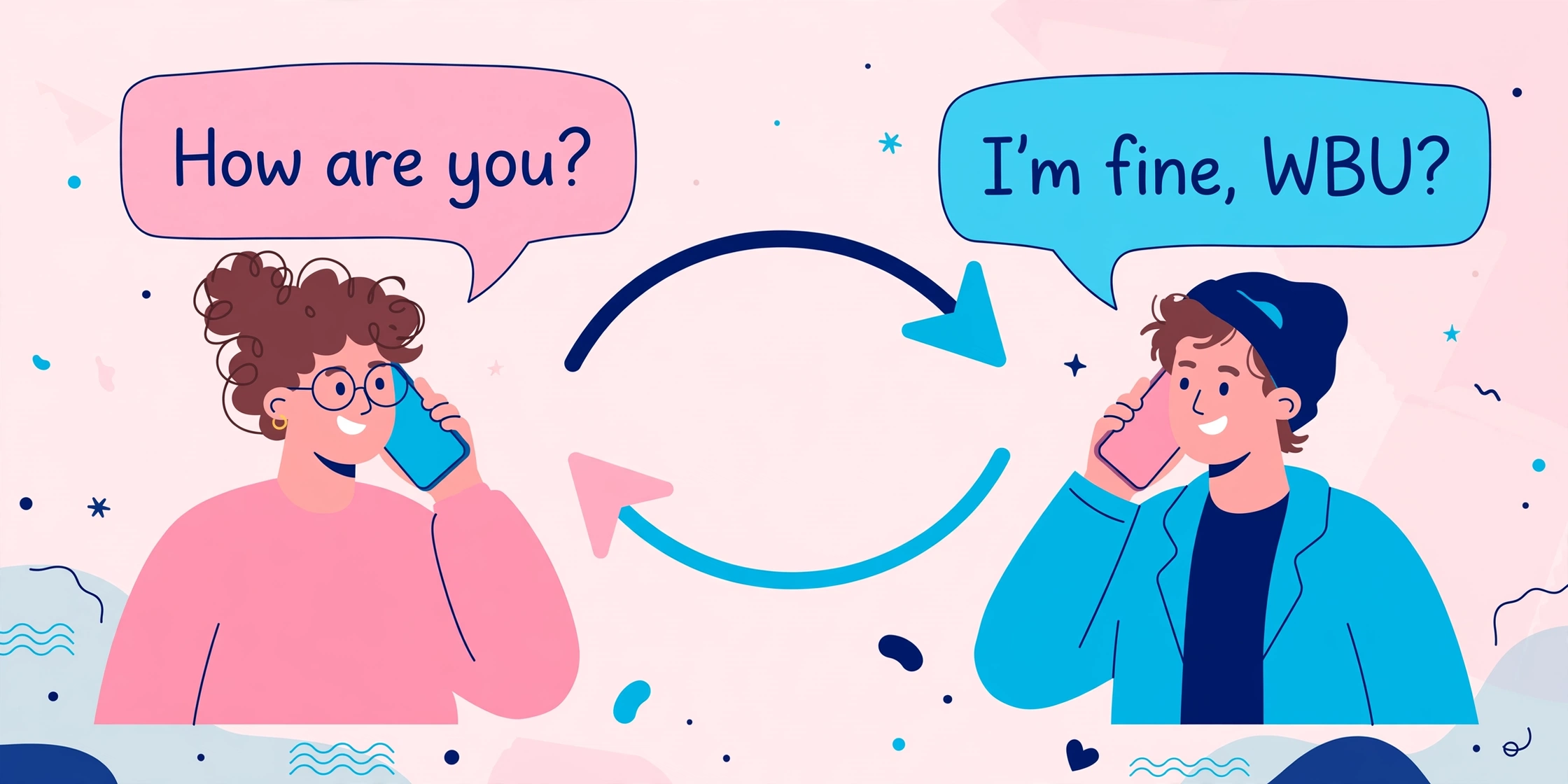
WBU stands for “What about you?” It is a casual texting abbreviation used to ask someone about their feelings, activities, opinions, or plans after sharing your own. For example, “I'm good, wbu?” means “I'm good, what about you?” You can usually reply by answering the same question.
What Does WBU Mean in Text Messages?
In text messages, WBU is a quick way to return a question to the person you're chatting with. Instead of repeating a complete sentence, the sender uses three letters to invite you to share your own answer.
For example, imagine a friend asks how your weekend went. You reply that you had a great time with your family and then ask, “WBU?” Your friend understands that you're asking about their weekend, too.
Here are a few everyday examples:
- “I'm feeling much better today, wbu?”
- “Just got home from work. WBU?”
- “I love watching comedy movies, wbu?”
- “I'm going out with my cousins tonight, wbu?”
- “My exams went pretty well. WBU?”
In each case, the abbreviation refers to the subject already being discussed. The sender isn't introducing an entirely new question. They're simply giving you a chance to share your side of the conversation.
How Can You Understand WBU Without Guessing?
The easiest method is to read the entire message rather than focusing only on the abbreviation.
Consider these three messages:
- “I'm hungry, wbu?” The sender wants to know whether you're hungry, too, or how you feel.
- “I'm choosing the blue one, wbu?” The sender wants to know which option you prefer.
- “I'm staying home tonight, wbu?” The sender is asking about your plans.
Notice that the same three letters can refer to different subjects. The underlying meaning remains “What about you?”, but the specific question comes from the conversation.
If the sender writes only “wbu?”, look at the previous messages. The answer is usually connected to the most recent question or topic.
What Does WBU Stand for, Letter by Letter?
WBU is an initialism formed from the phrase “What About You?” Each letter represents part of the original expression.
| Letter | Represents | Explanation |
|---|---|---|
| W | What | Introduces the question |
| B | About | Connects the question to the other person |
| U | You | Refers to the person receiving the message |
The letter U is a familiar texting substitute for the word “you.” Similarly, B represents “about” in the shortened phrase.
This kind of shorthand became useful as people started communicating through text messages, instant messaging services, and online chat rooms. Instead of typing the complete question every time, users could communicate the same idea with fewer characters.
However, WBU is not a separate English word. It is an abbreviation for a phrase that already exists in everyday conversation.
You can write it as “WBU,” “wbu,” or “Wbu.” The capitalization generally doesn't change its meaning.
How Is WBU Used in Everyday Conversations?
People use WBU in several situations, from ordinary small talk to discussions about entertainment, relationships, school, work, and weekend plans. Its purpose is usually to make a conversation more interactive.
1. Asking About Someone's Feelings
One common use is returning a question about someone's mood or well-being.
Example:
- Person A: “I'm doing great today!”
- Person B: “That's good! I'm pretty happy too, wbu?”
In this example, the sender wants to know how the other person feels. The abbreviation helps the conversation move naturally from one person's experience to the other's.
Another example:
- Person A: “I've been a little stressed lately. WBU?”
- Person B: “Same here, but I'm trying to relax more.”
The reply acknowledges the question and shares a personal feeling.
2. Asking About Plans
WBU is also useful when discussing future activities or arrangements.
Example:
- Person A: “I'm thinking about going to the movies on Saturday, wbu?”
- Person B: “I might go shopping with my sister.”
Here, the sender wants to know what the other person plans to do. The abbreviation doesn't necessarily mean the sender wants to make plans together. It simply asks about the recipient's plans.
If you're unsure whether an invitation is involved, respond to the question first. You can then ask whether the sender wants to meet up.
3. Sharing Preferences and Opinions
When someone shares an opinion, WBU can invite the other person to express a different or similar view.
Example:
- Person A: “I think summer is the best season. WBU?”
- Person B: “I'd choose fall because I love cooler weather.”
The sender isn't asking about your activities or emotions. They're asking for your opinion.
This use is especially common when people discuss favorite foods, music, movies, sports teams, hobbies, and travel destinations.
4. Keeping Small Talk Going
Sometimes, a conversation doesn't have a specific purpose. Two people simply want to check in or stay connected.
Example:
- Person A: “Not much, just relaxing at home. WBU?”
- Person B: “Same! I'm watching a new series.”
The abbreviation encourages the other person to contribute rather than allowing the conversation to end after a short response.
It can be particularly helpful when both people are getting to know each other and don't yet have many shared topics.
5. Asking About School or Work
Friends, classmates, and coworkers may use WBU to compare their experiences.
Example:
- Person A: “I finished my assignment early today, wbu?”
- Person B: “I'm still working on mine. I have one question left.”
The message sounds casual and conversational. In a formal workplace email, however, writing the complete phrase would usually be more appropriate.
What Does WBU Mean on Social Media?

The meaning of WBU generally stays the same across social media platforms: “What about you?” What changes is the kind of conversation in which it appears.
WBU on Instagram
In direct messages, people may use it to ask about your day, interests, opinions, or plans. If someone replies to your story with “That looks fun, wbu?”, they may be asking whether you've done something similar or what you're doing.
WBU on Snapchat
It can appear in quick conversations between friends or people getting acquainted. For example, “I'm just chilling, wbu?” asks what you're doing.
WBU on TikTok
Users may use it in comments or private messages to invite another person to share an opinion, reaction, or experience. The exact subject depends on the preceding conversation.
WBU on WhatsApp
Friends and family may use it in everyday messages about meals, work, family events, weekend plans, and personal updates.
These are examples of typical usage, not rules tied to a particular platform. WBU isn't exclusive to Instagram, Snapchat, TikTok, or WhatsApp. It can appear anywhere people exchange informal messages.
Does WBU Mean Something Different on Instagram or Snapchat?
Usually, no. If someone sends “wbu?” in an ordinary social conversation, the intended phrase is almost certainly “What about you?”
For instance:
- “I love this song, wbu?” asks whether you like it, too, or what you think of it.
- “I'm going to a party tonight, wbu?” asks about your plans.
- “I'm so tired today, wbu?” asks how you're feeling.
A specialized group, organization, or professional field could use the same letters for something else. If the abbreviation appears in a technical document or an unfamiliar business context, check the surrounding information instead of automatically assuming it is texting slang.
What Is the Difference Between WBU and HBU?
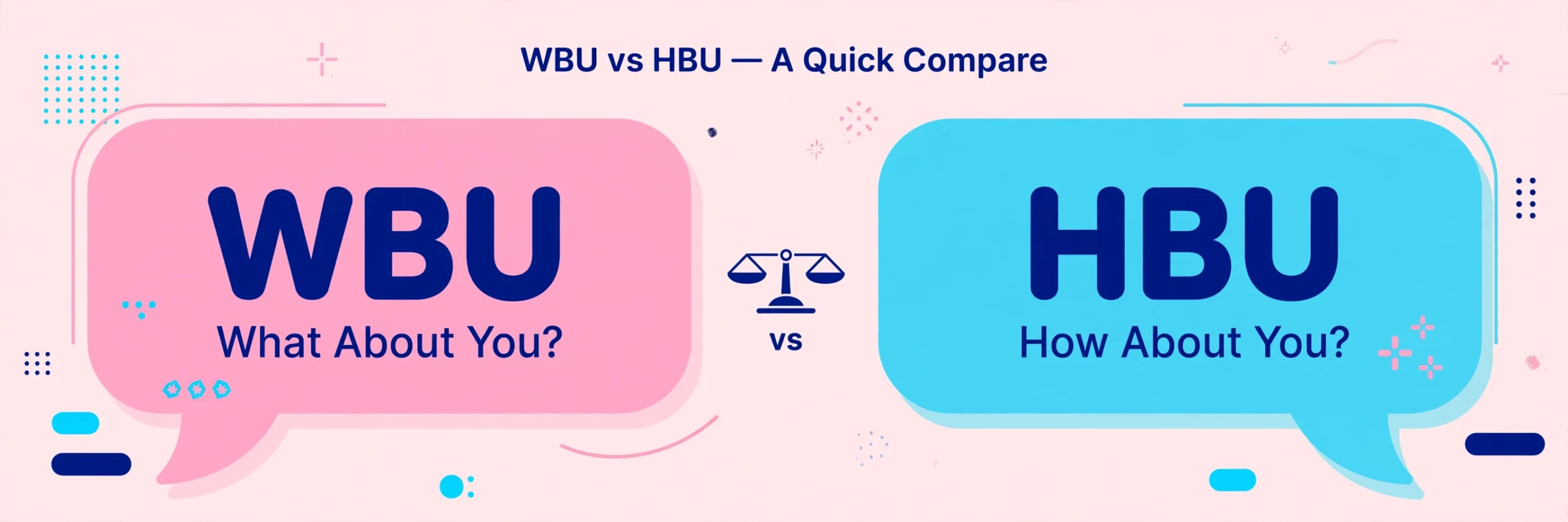
WBU and HBU are two closely related texting abbreviations.
- WBU means “What about you?”
- HBU means “How about you?”
In everyday texting, they often serve the same purpose: returning a question or inviting another person to share an answer. Their wording is slightly different, but the practical difference is usually small.
For example:
- “I'm doing well, WBU?”
- “I'm doing well, HBU?”
Both messages ask how the other person is doing.
The choice often comes down to personal preference, habit, and the way a person naturally phrases questions.
When Should You Use WBU Instead of HBU?
Use WBU when you want to ask “What about you?” after sharing information. Use HBU when “How about you?” sounds more natural in the sentence.
Both can work in conversations about plans, preferences, feelings, and everyday experiences.
For example:
- “I'm ordering pizza. WBU?” sounds natural when asking what someone else wants to eat.
- “I'm feeling great. HBU?” sounds natural when asking how someone feels.
These are tendencies rather than strict grammar rules. Either abbreviation can work in many of the same situations.
WBU vs. Other Common Texting Abbreviations
WBU is easy to understand once you know what it stands for, but it can be confused with other short expressions. The most important distinction is whether the sender is returning a question, asking what you're doing, or requesting specific information.
The following table compares common texting abbreviations and related phrases.
| Term | Full meaning | Main purpose | Example |
|---|---|---|---|
| WBU | What about you? | Returns a question | “I love reading, wbu?” |
| HBU | How about you? | Returns a question | “I'm good, hbu?” |
| WYD | What are you doing? | Asks about current activities | “Wyd tonight?” |
| HRU | How are you? | Checks on someone's well-being | “Hey, hru?” |
| WYA | Where are you? | Asks about someone's location | “Wya right now?” |
| NM | Not much | Gives a brief response | “Nm, just relaxing.” |
| NVM | Never mind | Withdraws or dismisses a question | “Nvm, I figured it out.” |
| IDK | I don't know | Expresses uncertainty | “Idk what to choose.” |
| BTW | By the way | Introduces an additional point | “Btw, are you free?” |
| IMO | In my opinion | Introduces a personal viewpoint | “IMO, it's the best one.” |
These expressions may appear together in a single conversation, but they aren't interchangeable.
For example, WYD asks what someone is doing, while WBU generally returns a question already established by the conversation. IDK communicates uncertainty, whereas WBU invites the other person to respond.
Is WBU the Same as “And You?”
In many situations, yes. “And you?” can perform the same conversational function as WBU.
Consider these messages:
- “I'm from California. And you?”
- “I'm from California, wbu?”
- “I'm from California. What about you?”
All three invite the recipient to share where they're from.
The difference is style. “And you?” is natural in spoken English and writing, while WBU is primarily associated with informal digital communication. The full phrase is also easier to understand when the reader isn't familiar with internet slang.
Is WBU the Same as WYD?
No. Although the two abbreviations sometimes appear in similar conversations, their meanings differ.
WBU means “What about you?” It depends on the topic that came before it.
WYD means “What are you doing?” It directly asks about someone's activities.
For example:
- “I'm watching a movie, wbu?” asks what the recipient is doing or what their situation is.
- “Wyd?” asks what the recipient is doing, even if no previous activity has been mentioned.
The context can overlap, but the expressions have different functions.
How Do You Reply to WBU in a Text?

The easiest way to respond is to identify the question behind the abbreviation and answer it honestly. You don't need to repeat the full phrase or use another abbreviation if you don't want to.
Here are practical replies for different situations.
1. When Someone Asks How You're Doing
If someone says, “I'm good, wbu?”, they're inviting you to share how you're feeling.
Possible replies include:
- “I'm doing great, thanks for asking!”
- “Pretty good, just a little tired.”
- “I'm okay. It's been a long day.”
- “Doing well! How's your day going?”
- “Can't complain, honestly.”
Choose a response that reflects how you actually feel. A short answer is enough for casual conversation.
2. When Someone Asks About Your Plans
Suppose the message reads, “I'm staying home tonight, wbu?”
You could respond with:
- “I'm going out for dinner with friends.”
- “Probably staying home, too.”
- “I haven't decided yet.”
- “I'm planning to watch a movie.”
- “Nothing planned so far. Why?”
The last response is useful if you suspect the sender may be preparing to invite you somewhere. However, WBU alone does not automatically indicate an invitation.
3. When Someone Asks for Your Opinion
If the sender says, “I think this movie is amazing, wbu?”, they're looking for your opinion.
You can reply:
- “I love it, too!”
- “It's good, but I prefer the first one.”
- “Honestly, it's not really my type.”
- “I haven't watched it yet. Is it worth it?”
- “I'd give it an eight out of ten.”
You don't have to agree with the sender. The purpose of the question is to hear your perspective.
4. When You Want to Keep the Conversation Going
Sometimes a simple answer can make a conversation feel unfinished. Adding a relevant follow-up question can help.
For example:
Their message: “I'm learning to cook, wbu?”
Your reply: “I'm trying to improve my cooking, too! What's the best thing you've made so far?”
This answer does two things: it responds to the question and introduces a topic the other person can discuss.
You could also ask about a shared hobby, an upcoming event, a favorite show, or something the sender mentioned earlier.
5. When You Don't Have Much to Say
You don't need to invent an interesting update just because someone asks you a question.
Natural replies include:
- “Not much, just relaxing.”
- “Same old, same old.”
- “Nothing special today.”
- “Just taking it easy.”
- “Pretty quiet day so far.”
If you want to continue chatting, add a question or a small detail. If you're busy, a short and honest answer is perfectly fine.
6. When You Don't Understand the Previous Question
If you receive “wbu?” but can't tell what the person is asking about, don't guess.
You can respond with:
- “WBU about what? 😅”
- “Wait, which question do you mean?”
- “Are you asking about my plans?”
- “Sorry, I lost track. What were we talking about?”
These responses are especially useful in long conversations where several topics have been discussed.
What Does WBU Mean in Different Conversations?
Although the basic definition remains consistent, the subject of the question can change according to the situation.
The following original examples show how the abbreviation works in different contexts.
Example 1: A Conversation About Food
Person A: “I'm craving tacos tonight, wbu?”
Person B: “I'm thinking about getting sushi.”
Explanation: Person A shares a food preference and asks what Person B wants to eat. The abbreviation refers to the choice of dinner.
Example 2: A Conversation About Music
Person A: “I've been listening to Taylor Swift all week. WBU?”
Person B: “I've had a lot of indie music on repeat lately.”
Explanation: The sender is asking what kind of music the recipient has been listening to.
Example 3: A Conversation About Work
Person A: “Work was pretty busy for me today, wbu?”
Person B: “Mine was surprisingly quiet.”
Explanation: The sender wants to compare experiences at work.
Example 4: A Conversation About School
Person A: “I have two exams next week, wbu?”
Person B: “Just one, thankfully!”
Explanation: The sender asks about the recipient's academic schedule.
Example 5: A Conversation About the Weekend
Person A: “I'm visiting my grandparents this weekend. WBU?”
Person B: “I'm going hiking with a few friends.”
Explanation: WBU asks about weekend plans rather than asking how someone feels.
Example 6: A Conversation About Relationships
Person A: “I think honesty matters most in a relationship, wbu?”
Person B: “I agree. Communication is important, too.”
Explanation: The sender invites the other person to share a personal belief about relationships.
Example 7: A Conversation About Entertainment
Person A: “I just finished watching a horror movie. WBU?”
Person B: “I'm watching a comedy right now.”
Explanation: The abbreviation refers to what the recipient is watching or doing at that moment.
Example 8: A Conversation About Travel
Person A: “I'd love to visit New York someday, wbu?”
Person B: “Japan is at the top of my travel list.”
Explanation: The sender wants to know the recipient's travel preferences or dream destinations.
Example 9: A Conversation About Feelings
Person A: “I'm nervous about tomorrow's presentation, wbu?”
Person B: “A little nervous, but I think we'll do fine.”
Explanation: The question refers to the recipient's feelings about the upcoming event.
Example 10: A Conversation About Free Time
Person A: “I usually spend my free time reading, wbu?”
Person B: “I like going for walks and listening to podcasts.”
Explanation: Person A is asking how Person B likes to spend their free time.
These examples illustrate a simple principle: the words before WBU usually tell you what the sender wants to know. If the message is too short to make that clear, review the earlier conversation or ask a clarifying question.
What Does WBU Mean When Someone Likes You?
Receiving WBU from someone you like can make you wonder whether they're interested in you romantically. The abbreviation itself, however, does not prove attraction.
It is a conversational expression. Friends, family members, classmates, coworkers, and romantic interests can all use it.
The surrounding conversation provides more useful clues than the abbreviation alone.
Could WBU Be a Sign of Interest?
It may be part of a conversation in which someone is interested in getting to know you.
For example:
- “I love trying new restaurants, wbu?”
- “What do you usually do on weekends, wbu?”
- “I'm really enjoying talking to you. WBU?”
- “I like spending time outdoors. What about you?”
These questions can help people discover shared interests and learn more about each other. That can happen in a friendship or a romantic connection.
However, one message isn't enough to determine someone's feelings.
How Can You Tell Whether the Conversation Is Flirty?
Pay attention to the broader interaction rather than treating WBU as a secret romantic signal.
Possible signs of mutual interest may include:
- The person regularly initiates conversations.
- They ask thoughtful questions about your interests.
- They remember details you previously shared.
- They make an effort to continue the conversation.
- They suggest spending time together.
None of these behaviors proves romantic interest on its own. The most reliable way to understand someone's intentions is through consistent behavior and clear communication.
How Should You Reply to a Crush Who Sends WBU?
You can keep your reply friendly and natural without trying to decode every word.
For example:
Their message: “I'm just relaxing and watching a movie, wbu?”
Friendly reply: “I'm taking it easy, too. What movie are you watching?”
Playful reply: “Trying to find something good to watch. Any recommendations? 😊”
Slightly flirty reply: “Just relaxing. It would be more fun with good company, though 😉”
Use the tone that feels comfortable for you and suits the relationship. You don't need to flirt just because someone uses a texting abbreviation.
Where Did WBU Come From?
The exact origin of WBU is unclear. There is no reliably established inventor or universally accepted date when the abbreviation first appeared.
Its development fits into the broader history of internet slang and text messaging. As people began communicating through SMS, instant messaging services, and online chat rooms, they frequently shortened everyday phrases to make conversations quicker.
Expressions such as “what about you?” were natural candidates for abbreviation because people use them so often in ordinary conversation.
WBU also belongs to a wider group of short expressions that use letters to represent words. Examples include HBU for “How about you?”, WYD for “What are you doing?”, and IDK for “I don't know.”
Online slang references document WBU as a shorthand expression used in digital communication, but these records should not be mistaken for proof of the precise date or circumstances in which it originated.
Did WBU Originate With SMS Texting?
It is reasonable to connect WBU with the growth of text messaging and online chat, but it would be inaccurate to claim that it was definitely invented for SMS.
The abbreviation may have developed through informal online communication and spread across different messaging environments. Without reliable historical evidence identifying its first use, a precise origin story would be speculation.
What can be said confidently is that WBU represents a shortened version of an ordinary English phrase and is widely recognized in informal digital conversations.
Why Did WBU Become Popular in Online Chats?
Several practical features help explain why abbreviations like WBU remain useful.
- Speed: Typing three letters is quicker than typing the full phrase.
- Convenience: The abbreviation fits naturally into short messages and rapid exchanges.
- Familiarity: People who regularly use texting slang can understand it immediately.
- Conversational flow: It lets a sender answer a question and return it without repeating the entire sentence.
- Informal tone: It suits casual conversations where complete sentences aren't always necessary.
These are explanations for its usefulness, not evidence that one specific event caused WBU to become popular.
Is WBU Formal or Informal?
WBU is informal texting slang. It is suitable for casual messages, social media conversations, and chats with people who understand common internet abbreviations.
However, it is generally not the best choice for formal writing, official correspondence, academic work, or professional communication with unfamiliar recipients.
The full phrase is appropriate in more situations because it is clear to readers regardless of their familiarity with texting slang.
| Situation | Is WBU appropriate? | Better approach |
|---|---|---|
| Texting a close friend | Yes | “I'm good, wbu?” |
| Chatting with a sibling | Yes | “I'm staying in, wbu?” |
| Messaging someone you know casually | Usually | Use it if the conversation is informal |
| Talking to a new acquaintance | It depends | Use the full phrase if you're unsure |
| Sending a professional email | Usually not | Write “What about you?” or a specific question |
| Writing an academic assignment | No | Use complete, standard English |
| Writing a formal business proposal | No | Use precise, professional wording |
Can You Use WBU at Work?
You can use it in an informal workplace chat if the culture and relationship make texting shorthand acceptable. For example, coworkers who regularly exchange casual messages might write, “I'm available after lunch, wbu?”
In a formal email to a client, manager, recruiter, or business partner, a complete question is safer.
Instead of:
“I'm available tomorrow, wbu?”
Write:
“I'm available tomorrow. What time works best for you?”
The second version is clearer and more professional. It also asks for the information you actually need instead of relying on an informal abbreviation.
Does Capitalization Change the Meaning of WBU?
No. In ordinary texting, capitalization usually does not change the meaning.
You may encounter all these versions:
- WBU?
- wbu?
- Wbu?
- What about you?
- what about you?
They generally communicate the same question.
Lowercase typing is common in casual messaging because it feels quick and relaxed. Uppercase WBU may be used for emphasis, to make an abbreviation stand out, or simply because the sender prefers capital letters.
Punctuation can affect how a message feels, but not necessarily what the abbreviation means.
For example:
- “wbu?” looks like a straightforward question.
- “WBU??” might convey extra curiosity or excitement, depending on context.
- “wbu lol” may sound relaxed or playful.
- “WBU!” might be an informal way of expressing enthusiasm, although the wording is still understood through context.
Don't assume that uppercase letters mean the sender is angry. In a message such as “WBU?”, capitalization alone isn't enough to determine emotion.
What Does WBU Mean in Different Tones?
The abbreviation itself is neutral. The tone comes from the surrounding words, punctuation, relationship between the people, and subject of the conversation.
Friendly WBU
A friendly message often includes a warm response or a question about the recipient's life.
Example: “I'm having a pretty good day, wbu? 😊”
This sounds approachable and invites the other person to share.
Casual WBU
A casual message may be short and direct.
Example: “Just finished lunch, wbu?”
This is ordinary everyday texting. It doesn't necessarily carry a deeper meaning.
Curious WBU
When someone wants to learn more about your opinion or experience, the abbreviation may express curiosity.
Example: “I've never tried skiing before, wbu?”
The sender may be asking whether you have tried skiing, depending on what you discussed earlier.
Playful WBU
Emojis, humor, and playful wording can give the message a lighthearted tone.
Example: “I'm officially spending the weekend doing absolutely nothing 😂 wbu?”
The sender is joking about their plans while asking about yours.
Potentially Dry WBU
A very short message can sometimes feel impersonal, especially if the conversation repeatedly consists of one-word answers.
Example:
- Person A: “Good.”
- Person B: “Wbu?”
- Person A: “Fine.”
- Person B: “Cool.”
This exchange doesn't give either person much to respond to. However, WBU itself isn't rude or unfriendly. The conversation may simply lack detail, or one person may be busy.
If you want to make the conversation more engaging, share a little more information and ask a specific follow-up question.
Is WBU Rude, Dismissive, or Impolite?
Generally, no. WBU is a neutral, informal question rather than an insult or an inherently disrespectful expression.
It usually communicates that the sender wants to hear your answer after sharing their own.
For example, “I'm doing well, wbu?” is a normal way to exchange updates. It is not automatically dismissive just because it uses an abbreviation.
Nevertheless, tone can depend on the situation.
A person who responds to every message with a single abbreviation may appear uninterested, particularly if they never ask follow-up questions or contribute meaningful details. Another person may use short replies simply because they're busy, distracted, or accustomed to brief messages.
How Can You Tell Whether WBU Sounds Impolite?
Consider three things:
- The conversation before it: Does the abbreviation naturally return a question?
- The person's usual texting style: Do they normally use short expressions with everyone?
- The wider interaction: Do they show interest in other ways, such as asking questions or following up later?
One abbreviation is rarely enough to judge someone's intentions.
If you want to be warmer in your own messages, you can write the complete phrase and add a relevant question. For instance, “I'm doing well, thanks! How has your week been?” sounds conversational without requiring slang.
What Are the Most Common Misunderstandings About WBU?
Because texting abbreviations are short and depend on context, readers can sometimes interpret them incorrectly. The following points clear up common misconceptions.
Misunderstanding 1: WBU Always Asks What Someone Is Doing
Not necessarily. WBU asks “What about you?” The subject might be your activities, but it could also be your feelings, preferences, experiences, or opinions.
If the discussion is about favorite movies, the sender wants your opinion. If it is about weekend plans, they want to know what you're planning.
Misunderstanding 2: WBU and HBU Are Completely Different
Their full phrases are different, but their everyday conversational functions overlap considerably. Both are commonly used to return a question.
You don't need to memorize a complicated rule to choose between them. Use whichever expression fits your sentence naturally.
Misunderstanding 3: WBU Is Always Flirty
WBU isn't inherently romantic. Friends, relatives, classmates, and colleagues may use it in completely ordinary conversations.
Romantic interest depends on the broader interaction, not the abbreviation by itself.
Misunderstanding 4: WBU Is Only Used by Teenagers
There is no good reason to treat it as an age-exclusive expression. People who use digital messaging may encounter or use texting shorthand regardless of age.
Whether someone chooses to use WBU depends more on their communication habits and the situation than on a fixed age group.
Misunderstanding 5: WBU Is Appropriate in Every Message
Although it is easy to type, WBU is not suitable for every context. Formal correspondence and academic writing generally call for complete phrases and clear questions.
In professional settings, choosing standard English can help avoid confusion.
Misunderstanding 6: WBU Has One Meaning in Every Possible Context
In ordinary texting, “What about you?” is the established interpretation. However, the same letters can represent other terms in specialized settings or organizational names.
If WBU appears in a technical document, a business name, or a subject unrelated to conversation, consider the context before deciding what it means.
Misunderstanding 7: You Must Reply With Another Abbreviation
You don't. A natural answer in complete English is perfectly acceptable.
If someone writes, “I'm having a great day, wbu?”, you can answer, “I'm having a pretty good day, too. Thanks for asking!”
There is no requirement to mirror their spelling, capitalization, or texting style.
How Can You Use WBU Naturally Without Sounding Awkward?
If you want to use WBU in your own messages, focus on clarity rather than trying to include as much slang as possible.
Here are five practical tips.
- Share something first. WBU works naturally after you have answered a question or offered an update.
- Keep the subject clear. Make sure the recipient understands which question you're returning.
- Match the situation. Use it with people who are comfortable with casual texting.
- Avoid overusing it. Repeating WBU after every sentence can make a conversation feel mechanical.
- Add details when appropriate. A specific question often creates a better conversation than a generic one.
For example, instead of repeatedly sending “wbu?”, you could ask, “I'm planning to visit the beach this weekend. Do you have any plans?”
The complete question provides more information and gives the other person something specific to answer.
What Is a Better Alternative to WBU in Professional Communication?
Depending on the subject, several alternatives can sound more polished:
- “What about you?” for a general reciprocal question.
- “How about you?” when asking about someone's feelings, preferences, or plans.
- “What are your thoughts?” when requesting an opinion.
- “What works best for you?” when coordinating schedules.
- “Could you share your perspective?” when discussing a professional or academic topic.
- “And how has your experience been?” when inviting someone to describe an experience.
The best alternative is the one that clearly communicates what you want to know. A specific question is often more useful than a general one.
Key Takeaways
- WBU means “What about you?” It is an informal abbreviation used in texting and online conversations.
- The sender usually wants your answer, opinion, feelings, plans, or experience related to the current topic.
- WBU and HBU (“How about you?”) are often interchangeable in everyday chats.
- The abbreviation is generally neutral, not inherently rude or romantic. Context helps reveal the intended tone.
- For professional emails, academic work, and formal communication, writing the complete phrase or asking a specific question is usually better.
Frequently Asked Questions
1. What does WBU mean in texting?
WBU stands for “What about you?” It is a casual abbreviation used when someone shares information about themselves and asks you to share your own answer. For example, “I'm doing well, wbu?” means “I'm doing well. What about you?”
2. What does WBU mean from a girl?
When a girl sends WBU, she is generally asking you the same question or inviting you to share your thoughts, feelings, or plans. It does not automatically mean she likes you romantically. The surrounding conversation and her overall behavior provide more useful context.
3. What does WBU mean from a guy?
When a guy texts WBU, it generally means “What about you?” He may be asking how you're doing, what you're planning, or what you think about something. The abbreviation alone doesn't reveal whether he is flirting, being friendly, or simply continuing a conversation.
4. What does WBU mean on Snapchat?
On Snapchat, WBU usually means “What about you?” Someone might send “Nothing much, wbu?” to ask what you're doing. The abbreviation is common informal texting shorthand and isn't exclusive to Snapchat.
5. What does WBU mean on Instagram?
On Instagram, WBU typically means “What about you?” It can appear in direct messages or casual conversations about interests, plans, experiences, and opinions. For example, “I love this song, wbu?” invites you to share your opinion about the music.
6. What is the difference between WBU and HBU?
WBU stands for “What about you?” while HBU stands for “How about you?” Both can return a question or invite another person to share an answer. In casual texting, their meanings and uses overlap considerably.
7. How should I reply when someone texts WBU?
Answer the question implied by the conversation. If someone asks how you're doing, tell them how you feel. If they're discussing weekend plans, share yours. You can also ask a related follow-up question to keep the conversation going.
8. Does WBU mean “Where about you”?
No. In ordinary texting, WBU means “What about you?” It is not normally used as an abbreviation for “Where about you.” If someone wants to ask your location, WYA (“Where you at?”) is a more recognizable informal expression.
9. Is WBU considered slang?
Yes. WBU is commonly described as texting slang or an internet abbreviation. It shortens an everyday English expression and is mainly used in informal digital communication rather than formal writing.
10. Can I use WBU in a professional email?
It is generally better to avoid WBU in formal professional emails, particularly when writing to clients, managers, recruiters, or unfamiliar colleagues. Use “What about you?” or ask a specific question that clearly communicates what information you need.
11. Does WBU mean the same thing as “And you?”
In many conversations, yes. Both expressions can invite someone to answer the same question. For example, “I'm from Texas, and you?” and “I'm from Texas, wbu?” generally communicate the same idea, although WBU is more informal.
12. What does “I'm good, WBU?” mean?
It means “I'm good, what about you?” The sender is saying that they're doing well and asking how you're doing in return. A natural response could be “I'm good, too, thanks!” or “Pretty good, just a little tired.”
13. Should WBU be written in uppercase or lowercase?
Both forms are acceptable in casual messages. You can write WBU, wbu, or Wbu without changing the intended meaning. Lowercase is common in informal texting, but capitalization often comes down to personal preference.
14. What does WBU mean when someone sends it by itself?
When someone sends only “WBU?”, they're usually referring to a question or topic discussed earlier. Review the previous messages to identify what they want to know. If the conversation doesn't provide enough context, ask them to clarify.
15. Is WBU still used in modern texting?
WBU remains a recognizable abbreviation in online slang references and informal messaging. People may use it in texts, private messages, and casual online conversations. Its frequency varies by individual, platform, and social group, so not everyone will use or recognize it.
Conclusion
The wbu meaning is simple: “What about you?” It is a casual texting abbreviation that helps people exchange information, share opinions, discuss plans, and keep conversations moving. You may encounter it in text messages, social media chats, and other informal online conversations.
When someone sends WBU, look at the message that came before it to understand what they want to know. They might be asking about your mood, activities, preferences, or experiences. You can respond naturally with a short answer, a complete sentence, or a follow-up question.
Remember that WBU is generally informal and neutral. It does not automatically indicate flirting, rudeness, or a particular emotion. Understanding the context will help you interpret the message correctly and reply with confidence.